
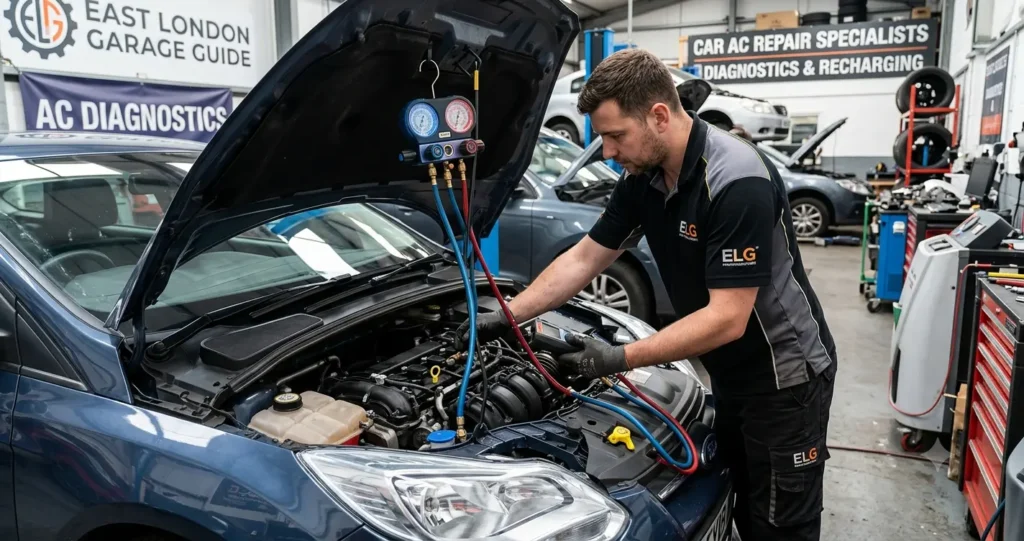
There’s nothing quite like getting into a hot car after a long day, turning the air conditioning to full blast, and… feeling nothing but warm air. It’s one of the most common complaints we hear at our East London garage, especially as the weather warms up. The good news is that most AC problems have a clear, identifiable cause and many are more straightforward and affordable to fix than drivers expect.
This guide walks through exactly why your car’s air conditioning might not be cooling properly, how the system actually works, what you can check yourself, and when it’s time to book a professional car AC repair.
How Car Air Conditioning Actually Works
Before diagnosing a fault, it helps to understand the basics. Your car’s AC system works using a refrigerant that cycles through four key stages:
- Compression The compressor pressurises the refrigerant gas, raising its temperature.
- Condensation The hot, pressurised gas passes through the condenser (located near the radiator), where it releases heat and turns into a high-pressure liquid.
- Expansion The liquid refrigerant passes through an expansion valve, dropping in pressure and temperature.
- Evaporation The cold, low-pressure refrigerant passes through the evaporator inside the cabin, absorbing heat from the air blown across it this is what produces the cold air you feel through the vents.
This cycle repeats continuously while the AC is running. If any single component in this chain fails or the refrigerant level drops, the whole system’s cooling performance suffers which is why AC problems can stem from several different causes even though the symptom (warm air) looks the same every time.
The Most Common Reasons Your Car AC Isn’t Cooling
1. Low Refrigerant Level
This is by far the most common cause of poor AC performance. Refrigerant doesn’t get “used up” through normal operation — if the level is low, it’s almost always because of a leak somewhere in the system, even a very small one.
Symptoms: Air is only slightly cool, or cool for a short period before warming up again. Cooling performance may have gradually declined over months or years rather than failing suddenly.
What’s needed: A proper AC service that includes leak detection, not just a simple refrigerant top-up. Topping up refrigerant without finding and fixing the leak means you’ll be back to square one within months.
2. Failing AC Compressor
The compressor is essentially the heart of the AC system, and it’s also one of the more expensive components to replace. Compressors can fail due to age, lack of use (which is more common than people expect running your AC for a few minutes even in winter helps keep seals lubricated), or damage from low refrigerant levels causing it to run without adequate lubrication.
Symptoms: A loud or unusual noise when the AC is switched on, the compressor clutch not engaging (often noticeable as a clicking sound that doesn’t quite catch), or a complete lack of cooling regardless of settings.
What’s needed: Diagnostic testing to confirm whether the compressor itself has failed or whether it’s a related electrical or refrigerant issue causing it to underperform.
3. Electrical Faults
Your AC system relies on several electrical components — sensors, relays, the compressor clutch, and control modules — to function correctly. A fault in any of these can prevent the AC from engaging properly, even if the mechanical components are otherwise healthy.
Symptoms: The AC works intermittently, doesn’t respond to temperature adjustments, or the compressor doesn’t engage at all despite refrigerant levels being fine.
What’s needed: A proper diagnostic check to trace the electrical fault, since guessing at electrical issues often leads to replacing parts that weren’t actually the problem.
4. Blocked or Dirty Cabin Air Filter
This is one of the simplest and most affordable causes to fix. A clogged cabin air filter restricts airflow through the vents, which can make the AC seem weaker even if the cooling system itself is working perfectly.
Symptoms: Weak airflow from the vents, a musty smell when the AC is running, or the AC seeming to cool slowly compared to before.
What’s needed: A simple cabin filter replacement often one of the most cost-effective AC-related fixes available.
5. Condenser Issues
The condenser, located at the front of the car near the radiator, is responsible for releasing heat from the refrigerant. Because of its position, it’s vulnerable to damage from road debris, and it can also become blocked with dirt, leaves, or insects over time, reducing its efficiency.
Symptoms: Reduced cooling performance, particularly noticeable in slow-moving or stationary traffic when airflow across the condenser is lower.
What’s needed: A visual inspection for physical damage or blockages, with cleaning or replacement depending on the extent of the issue.
6. Refrigerant Leaks at Seals and Hoses
Over time, the rubber seals, O-rings, and hoses in the AC system can degrade, particularly with age or extreme temperature exposure. Even a very small leak can gradually reduce refrigerant levels enough to noticeably affect performance.
Symptoms: A gradual decline in cooling performance over weeks or months, sometimes with a faint chemical smell when the AC is running.
What’s needed: Dye-based or electronic leak detection to pinpoint the exact source, followed by a seal, hose, or component replacement as needed.
Quick Self-Checks Before Booking a Repair
While most AC repairs need professional equipment, there are a few things you can check yourself first:
- Check the cabin air filter. If it hasn’t been replaced in over a year, or is visibly dirty, this is a simple and affordable first step.
- Make sure the AC has been used recently. If the car has been sitting unused for a long period, run the AC for several minutes to check whether performance improves as the system recirculates.
- Check for visible debris on the condenser. If you’re comfortable doing so, a quick look at the front of the car (behind the front grille) can reveal obvious blockages like leaves or debris.
- Listen for unusual noises when switching the AC on. A loud clicking, grinding, or squealing noise suggests a mechanical issue rather than a simple refrigerant problem, and is worth mentioning when you book a repair.
If none of these resolve the issue, it’s time for a proper diagnostic AC check rather than continuing to guess.
What Happens During a Professional Car AC Repair
At our East London garage, a proper AC repair typically follows this process:
- Initial assessment. We ask about the symptoms — how the AC is behaving, when the problem started, and whether performance has changed gradually or suddenly.
- Pressure and performance testing. We check the system’s refrigerant pressure and overall cooling performance against expected values for your vehicle.
- Leak detection. If refrigerant levels are low, we use appropriate detection methods to identify the exact source of the leak, rather than simply topping up and hoping it lasts.
- Component inspection. We check the compressor, condenser, cabin filter, and related electrical components to identify the root cause.
- Clear repair advice. We explain what we’ve found and the recommended repair options before any work begins, so you understand exactly what’s needed and why.
- Repair and recharge. Once the issue is identified and fixed, the system is properly recharged with the correct type and amount of refrigerant for your vehicle.
Why DIY Refrigerant Top-Up Kits Aren’t Always a Good Idea
Over-the-counter AC recharge kits are widely available and can seem like a quick, affordable fix. However, they come with real drawbacks:
- They don’t fix leaks if your refrigerant is low because of a leak, a DIY top-up is a very temporary fix at best.
- Overcharging the system is a common mistake, which can actually reduce cooling performance and put unnecessary strain on the compressor.
- They don’t diagnose the underlying issue, meaning you could be masking a bigger problem (like a failing compressor) rather than addressing it.
- Incorrect refrigerant type or handling can damage the system, particularly on newer vehicles with more sensitive AC components.
If you’ve already tried a DIY kit without lasting success, that’s actually useful diagnostic information it strongly suggests a leak or a more significant fault that needs proper attention rather than another top-up.
Preventative Tips to Keep Your Car AC Running Well
- Run your AC year-round, even briefly during winter months. This helps keep seals lubricated and prevents them from drying out and cracking.
- Replace your cabin air filter annually, or more often if you drive in dusty or polluted conditions.
- Get your AC checked as part of your regular service, rather than waiting until it fails completely, especially before summer when garages tend to get busier with AC-related bookings.
- Address small performance drops early. A slight decline in cooling is far easier and cheaper to diagnose and fix than a complete system failure.
When to Book a Professional AC Repair
Book a professional check if you notice any of the following:
- Warm air blowing even with the AC on max
- Weak airflow from the vents
- Unusual noises when the AC is switched on
- A musty or chemical smell from the vents
- AC that cools initially but warms up again quickly
- AC performance that’s noticeably worse than the same time last year
Why AC Problems Seem to “Appear Suddenly” Even Though They Build Gradually
One of the most common things drivers say when booking an AC repair is that the problem “came out of nowhere.” In reality, most AC faults develop gradually over months, but the symptoms often only become noticeable once performance crosses a certain threshold.
A slow refrigerant leak, for example, might reduce cooling performance so gradually that you don’t consciously register the change day-to-day until a genuinely hot day arrives and the system simply can’t keep up anymore. The fault didn’t appear overnight; it had been quietly developing for a while, and the first hot spell of the year just exposed it.
This is exactly why booking an AC check in spring, before the summer heat arrives, tends to be a smarter approach than waiting until the first heatwave. Not only are garages generally less busy earlier in the season, but catching a small leak or early compressor wear before it fully fails is usually a smaller, more affordable job than dealing with a complete breakdown of the system during peak summer demand.
The Real Cost of Delaying an AC Repair
Beyond simple discomfort, delaying an AC repair can have knock-on effects worth understanding:
A struggling compressor running on low refrigerant wears out faster
What might have been a straightforward refrigerant top-up and leak repair can turn into a full compressor replacement if the system continues to run under abnormal conditions for an extended period.
Small leaks get larger
Rubber seals and hoses that are already degrading don’t tend to improve with time or use — a minor leak today is more likely to become a larger one next month than to seal itself.
Cabin air quality can decline
A poorly maintained AC system, particularly one with a neglected cabin filter, can circulate more dust, pollen, and odours into the cabin, which matters for allergy sufferers and anyone who spends significant time in the car.
Demisting performance suffers too
Many drivers don’t realise that the AC system plays a role in demisting the windscreen, even outside of summer. A faulty AC system can mean slower demisting in damp or cold weather, which has a genuine safety impact on visibility.
AC Repair Across the Seasons: What to Expect
Spring: The best time to book a proactive AC check, before demand increases and before you actually need the system at full performance.
Summer: The busiest period for AC-related bookings, since this is when faults that have been quietly developing finally become impossible to ignore. Booking early in the season, rather than during the first heatwave, usually means a shorter wait.
Autumn: A good time to address any AC issues you noticed but didn’t get around to fixing over summer, while demand is lower and before winter driving conditions make demisting performance more important.
Winter: Don’t switch your AC off completely just because it’s cold. Running it periodically, even for a few minutes, helps maintain seal condition and can prevent leaks from developing by the time summer arrives again.
AC Repair Costs: What Influences the Price
It’s natural to want a ballpark figure before booking a repair, and while exact pricing depends on your vehicle and the specific fault found, the general cost of AC-related work tends to fall into a few tiers based on complexity:
Lower-cost fixes typically include cabin air filter replacement and straightforward refrigerant top-ups where no leak is present (which is genuinely uncommon, but does happen, particularly after certain types of AC-related work elsewhere in the vehicle).
Mid-range repairs often involve leak detection and repair at a specific seal, hose, or fitting, along with a full system recharge once the leak has been resolved.
Higher-cost repairs generally involve component replacement, such as a failing compressor or condenser, particularly on vehicles where these parts are more expensive or labour-intensive to access.
The reason we always recommend a diagnostic check before quoting is straightforward: guessing at the cause without testing risks either under-quoting (and finding a bigger issue once work begins) or over-quoting for a repair that turns out to be far simpler than expected. A proper assessment protects you from both.
What Good AC Servicing Looks Like Long-Term
Treating your AC system as part of your regular vehicle maintenance, rather than something you only think about when it stops working, tends to save money and hassle over the life of the car. A sensible long-term approach includes:
- Including a basic AC performance check as part of your annual service, even if nothing seems wrong
- Replacing the cabin air filter on a regular schedule, typically annually
- Running the AC periodically year-round, rather than leaving it unused for months at a time
- Addressing small, gradual drops in performance early, rather than waiting until the system fails to cool at all
- Booking a proper diagnostic check rather than relying on DIY top-up kits when performance does decline
This approach doesn’t just keep you comfortable during the warmer months — it protects more expensive components like the compressor from premature wear, which is ultimately where the bulk of AC-related repair costs tend to come from.
Final Thoughts
A car AC that isn’t cooling properly is rarely a mystery once it’s been properly diagnosed — the challenge is that several different faults can produce the exact same symptom of warm air. Rather than guessing with a DIY top-up kit and hoping for the best, a proper diagnostic check identifies the actual cause, whether that’s a simple filter replacement or a more involved leak repair.
If your AC isn’t performing the way it should, don’t wait for the next heatwave to find out how bad it’s become. Book a car AC repair with our East London garage and get back to driving in comfort.
Frequently Asked Questions
Why does my car AC only blow cold air sometimes?
Intermittent cooling is often linked to low refrigerant levels caused by a small leak, or an electrical fault causing the compressor to engage inconsistently. A diagnostic check can identify which of these is causing the issue in your specific vehicle.
How often should I get my car’s AC serviced?
Most manufacturers recommend an AC service or check every one to two years, since refrigerant levels and seal condition can gradually decline even without an obvious leak. Getting it checked as part of your regular car service is a convenient way to stay on top of this.
Can low refrigerant damage my AC compressor?
Yes, running the AC with low refrigerant can cause the compressor to operate without adequate lubrication, which increases wear and can lead to premature failure. This is one of the reasons it’s important to address low refrigerant levels rather than ignoring reduced cooling performance.
Is it normal for my car AC to smell musty?
A musty smell is usually caused by moisture and bacteria buildup on the evaporator, often linked to a dirty cabin air filter or the AC system not being used regularly. This is generally straightforward to resolve with a filter replacement and, in some cases, an evaporator clean.
How much does car AC repair cost?
Cost varies significantly depending on the cause, ranging from an affordable cabin filter replacement to a more involved compressor or leak repair. We recommend a diagnostic check first so we can give you an accurate quote based on the actual fault, rather than an estimate based on guesswork.
Can I use my car’s AC in winter, or should I switch it off completely?
It’s actually good practice to run your AC briefly even in colder months, since regular use helps keep the system’s seals lubricated and can help prevent leaks from developing due to dried-out components.
Will topping up refrigerant myself fix the problem permanently?
Not usually. If refrigerant levels are low, it’s almost always due to a leak somewhere in the system, and a DIY top-up doesn’t address that underlying cause. Performance will likely decline again over time until the actual leak is found and repaired.