
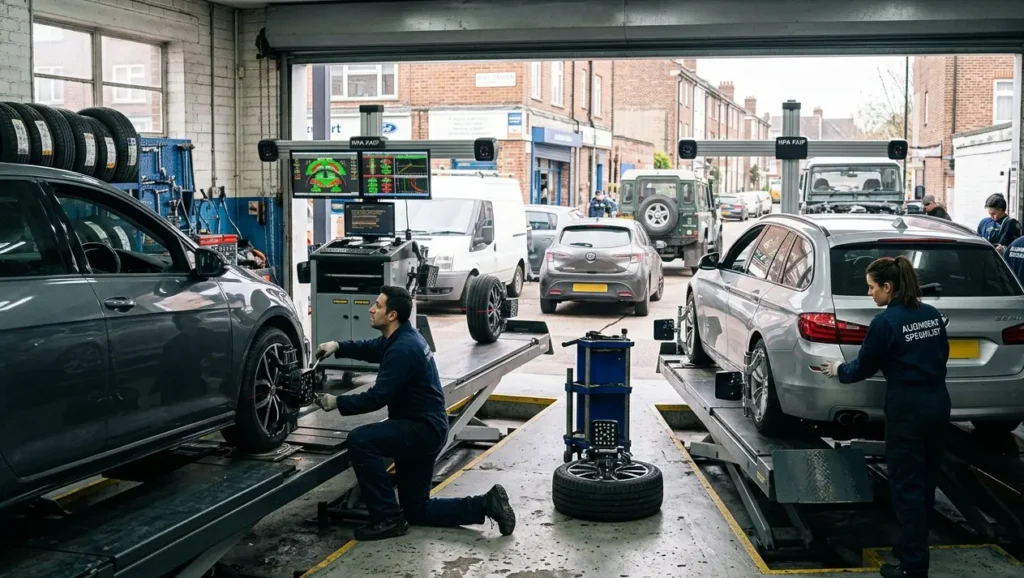
If your steering wheel isn’t sitting straight when you’re driving in a straight line, or you’ve noticed your car gently drifting towards the kerb the moment you take your hands off the wheel, there’s a good chance your wheel alignment is out. It’s one of the most common and most overlooked issues we see on cars coming into our East London garage, and it’s rarely caused by anything dramatic. Most of the time it’s a pothole on the A13, a sharp kerb clip while parallel parking in Ilford, or simply months of wear working its way through ageing suspension bushes.
The problem is that misalignment doesn’t announce itself loudly. It creeps in gradually, quietly wearing down your tyres, pulling at your fuel economy, and making the car feel slightly “off” in a way that’s easy to dismiss. By the time most drivers book a check, they’ve usually already paid for it in a set of tyres worn unevenly on one edge, or in fuel that’s been burned fighting against wheels that aren’t pointing the same way.
This guide covers everything you need to know: what wheel alignment actually is, the signs that tell you it’s time to get it checked, what affects the cost, how the process works at our garage, and when East London’s roads make a check especially worthwhile. By the end, you’ll know exactly what to look for and what to expect when you book.
What Is Wheel Alignment?
Wheel alignment is the adjustment of your car’s suspension geometry not the wheels or tyres themselves, but the angles at which they sit relative to each other and to the road. Every vehicle manufacturer sets precise specifications for these angles, and even a small deviation can throw off handling, tyre wear and stability.
Three angles matter most:
Toe
Toe is the angle of the wheels when viewed from above whether they point slightly inward (“toe-in”) or outward (“toe-out”) relative to the direction of travel. Incorrect toe is the single biggest cause of rapid, uneven tyre wear, and it’s usually the angle most affected by pothole and kerb impacts.
Camber
Camber is the tilt of the wheel when viewed from the front of the car whether the top of the tyre leans inward (negative camber) or outward (positive camber). Wrong camber wears one edge of the tyre faster than the other and can affect cornering grip.
Caster
Caster is the forward or backward tilt of the steering axis when viewed from the side of the car. It affects steering stability, self-centring and how the car feels at motorway speed. Caster issues are less common day-to-day but can result from accident damage or worn suspension components.
Expert Tip: If your tyre wear looks like feathering (smooth on one side, sharp on the other when you run your hand across the tread), that’s almost always a toe problem book an alignment check before you buy new tyres, or you’ll wear the new ones out too.
Wheel Alignment vs Wheel Balancing vs Wheel Tracking
These three terms get mixed up constantly, and confusing them means drivers often book the wrong service. Here’s the difference, in plain terms.
| Service | What it fixes | Common symptom |
| Wheel alignment / tracking | Suspension angles (toe, camber, caster) | Car pulls to one side, uneven tyre wear, off-centre steering wheel |
| Wheel balancing | Uneven weight distribution around the wheel and tyre | Vibration through the steering wheel or seat, usually at higher speeds |
| Tyre balancing | Same as wheel balancing the terms are used interchangeably | Steering wheel shake at motorway speed |
Wheel tracking is simply another name for wheel alignment it’s the term used more often in the UK, particularly for the toe angle specifically, while “alignment” is the more general term covering all three angles. If you search “wheel tracking near me” or “wheel alignment near me,” you’re looking for exactly the same service.
Wheel balancing, by contrast, has nothing to do with suspension angles. It corrects tiny weight variations in the wheel and tyre assembly by adding small weights, which stops the wheel vibrating as it spins. A car can be perfectly aligned and still need balancing, and vice versa they’re separate jobs, sometimes done together.
2-Wheel vs 4-Wheel Alignment
This is one of the most common questions we get, and the honest answer is: it depends on your car and your symptoms.
2-wheel alignment (front only) adjusts the toe angle on the front axle. It’s quicker and cheaper, and it’s often sufficient for cars with a fixed (non-adjustable) rear axle, which is common on many smaller hatchbacks.
4-wheel alignment checks and adjusts all four wheels, ensuring the rear axle is aligned to the front (thrust angle) as well as the front wheels being set correctly. This is essential for:
- Cars with independent rear suspension (most modern saloons, estates, SUVs and premium hatchbacks)
- Vehicles that have had rear suspension work, a rear tyre change, or rear-end accident damage
- Cars showing a “dog-tracking” appearance (the rear of the car doesn’t quite follow the same line as the front)
If you’re not sure which your car needs, that’s fine we check the setup and recommend the correct service rather than upselling you unnecessarily.
Laser Alignment and Hunter Alignment Technology
Old-style alignment used physical gauges and string lines slow, and only ever as accurate as the person operating them. Modern garages, including ours, use laser and camera-based alignment systems, with Hunter Engineering equipment being the industry standard across the UK for its accuracy and repeatability.
Here’s how it works in practice: sensors are clamped to each wheel, and the system uses cameras or lasers to measure the exact toe, camber and caster angles in real time, cross-referencing them against the manufacturer’s specification for your exact make, model and year. Any deviation shows up instantly on screen, in fractions of a degree, and the technician adjusts the suspension while watching the live readout rather than guessing and re-measuring repeatedly.
Why this matters for you:
Precision alignment isn’t just about ticking a box. A car set even half a degree out of spec on toe can wear through a set of tyres years before it should.
12 Signs You Need a Wheel Alignment Check
If you notice one or more of these, it’s worth booking a check. You don’t need to wait for all of them to appear.
- The car pulls to one side when driving on a flat, straight road with no crosswind.
- Steering wheel off centre you have to hold it slightly turned to drive straight.
- Uneven tyre wear, especially on the inner or outer edge of one or more tyres.
- Feathered or “sawtooth” tread wear you can feel by running a hand across the tyre.
- Squealing tyres on turns, even at moderate speed.
- Vibration through the steering wheel, though this can also indicate a balancing issue.
- The steering wheel doesn’t self-centre properly after a turn.
- Handling feels vague or “loose,” particularly at motorway speed.
- A recent pothole or kerb impact even a low-speed one.
- New tyres wearing unevenly within a few months of fitment.
- The car “dog-tracks,” appearing to travel slightly sideways visible from behind on a straight road.
- A recent front-end knock, minor collision, or new/lowered suspension fitment.
Warning: Continuing to drive on badly misaligned wheels doesn’t just cost you in tyres it affects how quickly and predictably your car responds in an emergency stop or swerve. If you notice several of the signs above together, don’t wait for your next MOT to get it checked.
10 Common Causes of Wheel Misalignment
- Potholes sudden, sharp impacts are the number one cause we see in East London, particularly after winter frost damage to road surfaces.
- Kerb strikes, especially common in tight parking on residential streets.
- Worn suspension components bushes, ball joints and tie rod ends degrade over time and let angles drift.
- Minor collisions, even low-speed bumps that don’t leave visible bodywork damage.
- Aggressive or high-mileage driving, particularly on poorly maintained roads.
- Aftermarket lowering springs or suspension modifications fitted without a follow-up alignment.
- Uneven tyre pressure maintained over long periods.
- Towing heavy loads regularly, which stresses the rear suspension geometry.
- General wear and tear alignment can drift gradually even without a specific impact.
- Incorrect fitment after suspension or steering repairs, if alignment wasn’t checked afterwards.
15 Benefits of Correct Wheel Alignment
- Longer tyre life often extending tread life by thousands of miles.
- Even tyre wear, so you replace all four tyres together rather than one prematurely.
- Improved fuel economy, since misaligned wheels create extra rolling resistance.
- Straighter, more predictable steering.
- Reduced strain on suspension components, extending their lifespan too.
- Better braking performance and stability under hard braking.
- Improved handling and cornering grip.
- A smoother, quieter ride.
- Reduced steering wheel vibration.
- Lower risk of a tyre blowout caused by excessive edge wear.
- Better resale value, since a well-maintained chassis reflects well at inspection.
- Improved safety in emergency manoeuvres.
- Less driver fatigue on long journeys, since you’re not fighting a pulling car.
- Peace of mind for MOT time, since excessive uneven tyre wear can contribute to an MOT advisory or fail.
- Overall lower running costs across tyres, fuel and suspension parts combined.
Risks of Ignoring Misalignment
We see the consequences of ignored alignment issues every week. The most common real-world example is a driver who’s hit a pothole hard on a route like the A406 or A13, felt a slight pull afterwards, and put it down to “the car settling back in.” Six months later, they’re back in because a brand-new set of tyres has worn unevenly on the inside edge sometimes down to the canvas on one side while the rest of the tread looks almost new.
Tyre damage is the most expensive consequence, because it’s not covered by any warranty tyre manufacturers won’t cover wear caused by misalignment. Suspension wear accelerates too, since components are working at incorrect angles under load. Fuel economy drops gradually, often by a noticeable margin over months, because misaligned wheels create constant low-level resistance the engine has to overcome. And from a steering safety perspective, a misaligned car is less predictable in an emergency stop, on a wet road, or in a sudden swerve exactly the moments when predictable handling matters most.
Myth vs Fact
| Myth | Fact |
| “My car drives fine, so alignment must be OK.” | Misalignment often shows no obvious symptom until tyre wear becomes visible by which point damage is already done. |
| “Wheel alignment and wheel balancing are the same thing.” | They correct completely different problems see the comparison table above. |
| “Only old or high-mileage cars need alignment checks.” | Any car can be knocked out of alignment by a single pothole or kerb strike, regardless of age. |
| “New tyres fix wear caused by misalignment.” | New tyres fitted to a misaligned car will simply wear unevenly again alignment should be checked at the same time. |
How Often Should Wheel Alignment Be Checked?
As a general rule, we recommend a wheel alignment check at least once a year, or roughly every 10,000–12,000 miles ideally alongside a service or MOT. But annual checks are the minimum; several situations call for an immediate check regardless of when your last one was.
Book a check immediately after:
- Hitting a pothole hard even if the car “feels fine” afterwards.
- A kerb impact, especially while parking or turning tightly.
- Any accident, however minor, involving the front or rear of the car.
- Fitting new tyres this is the ideal moment to check alignment, since worn tyres often mask early symptoms.
- Suspension repair or replacement work, including bushes, arms, or shock absorbers.
- Fitting lowering springs or coilovers, which change the suspension geometry.
- Seasonally, particularly after winter, when frost damage tends to worsen pothole conditions on East London roads.
Booking Checklist get a check if any of these apply to you:
- Hit a pothole or kerb in the last month
- Steering wheel isn’t centred when driving straight
- Tyres show uneven wear on inspection
- New tyres about to be fitted
- Suspension work recently carried out
- Haven’t had a check in over a year
Wheel Alignment Cost: What Affects the Price
We won’t invent a fixed price here, because doing so would be misleading alignment pricing genuinely varies based on several factors, and any garage quoting a single flat figure for every vehicle is oversimplifying it. Here’s what actually determines your cost:
- 2-wheel vs 4-wheel alignment 4-wheel jobs take longer and involve more adjustment points, so they typically cost more than a front-only check.
- Vehicle type larger vehicles, performance cars, and vehicles with more complex multi-link suspension generally take longer to set up correctly than a standard hatchback.
- How far out of alignment the car is a car that’s only slightly out takes less time to correct than one that needs significant adjustment, particularly if seized or corroded adjusters need freeing off first.
- Whether additional parts are needed occasionally a worn track rod end or bush needs replacing before alignment can be corrected properly, which affects overall cost.
What’s included in our alignment check: a full computerized measurement against manufacturer specification, adjustment of the relevant angles, a road test to confirm the fix, and a printed before-and-after report you can keep.
The most accurate way to get a price for your specific vehicle is to contact us directly we’ll ask for your registration and give you a straightforward, no-obligation quote before you book anything in.
How Our Wheel Alignment Process Works
- Inspection we start with a visual check of tyres, suspension components and steering, since worn parts can affect the accuracy of an alignment and should be flagged before adjustment.
- Measurement the car goes onto our alignment rack and sensors are fitted to each wheel.
- Computer diagnostics our Hunter laser system measures toe, camber and caster in real time against your exact manufacturer specification.
- Adjustment our technician corrects any angles that fall outside tolerance, working from the live readout.
- Road testing where needed, we road test to confirm the car tracks straight and the steering wheel sits centred.
- Final report you receive a printed before-and-after report showing the readings, so you can see exactly what was corrected.
Why Choose Car Garage East London
- Hunter laser alignment technology the same precision equipment used by main dealerships, calibrated for accuracy.
- Experienced technicians who work on alignment day in, day out, not as an occasional add-on service.
- Transparent, no-surprise pricing you get a proper quote before any work starts.
- Fast appointments we understand a pulling car isn’t something you want to leave for weeks.
- Printed before/after alignment report with every check, so you can see the actual readings.
- Conveniently located for East London drivers, serving East Ham, Barking, Ilford, Plaistow, Beckton, Stratford, Dagenham, Canning Town, Forest Gate and Wanstead.
- Honest recommendations if your car only needs 2-wheel alignment, we won’t sell you 4-wheel.
Frequently Asked Questions
How do I know if I need a wheel alignment?
The clearest signs are your car pulling to one side on a flat road, your steering wheel sitting off-centre when driving straight, or uneven wear across your tyres. If you’ve recently hit a pothole or kerb, it’s worth getting checked even without obvious symptoms, since misalignment doesn’t always feel dramatic at first.
What’s the difference between wheel alignment and wheel tracking?
Nothing they’re the same service. “Wheel tracking” is simply the more common UK term, often referring specifically to the toe angle, while “wheel alignment” covers toe, camber and caster together. If you search either term, you’ll find the same service.
How much does wheel alignment cost near me?
Price depends on your vehicle, whether you need 2-wheel or 4-wheel alignment, and how far out of specification the car is. Rather than relying on a generic online figure, contact us with your registration for an accurate, no-obligation quote.
Can I drive with misaligned wheels?
You can, but it’s not advisable for long. Misalignment accelerates tyre wear, reduces fuel economy, and can affect handling and braking predictability, particularly in an emergency situation. It’s best addressed as soon as you notice symptoms rather than left to worsen.
How long does a wheel alignment take? A standard alignment check and adjustment typically takes under an hour, though this can vary depending on how far out of specification the car is and whether any adjusters are seized or corroded, which can add time.
Will wheel alignment fix a vibrating steering wheel?
Not necessarily. Vibration is more commonly linked to wheel balancing rather than alignment. We’ll check both during inspection and recommend the correct fix rather than assuming the two issues have different causes and different corrections.
Do I need 2-wheel or 4-wheel alignment?
It depends on your car’s suspension design and symptoms. Cars with independent rear suspension, or those showing rear tyre wear or a “dog-tracking” appearance, usually need 4-wheel alignment. We’ll assess your car and recommend the correct option.
How often should wheel alignment be checked?
As a general guide, once a year or every 10,000–12,000 miles, ideally alongside a service. You should also get an immediate check after hitting a pothole or kerb, following an accident, or after fitting new tyres or suspension parts.
Does hitting a pothole always cause misalignment?
Not always, but it’s one of the most common causes we see, particularly with sharp, sudden impacts. Even if the car feels fine immediately afterwards, it’s worth a check, since early misalignment doesn’t always produce noticeable symptoms straight away.
Can wheel alignment improve fuel economy?
Yes. Misaligned wheels create additional rolling resistance, meaning the engine works harder to maintain speed. Correcting alignment reduces this resistance, which can lead to a noticeable improvement in fuel economy over time.
Is wheel alignment covered under my car’s warranty?
This depends on your manufacturer warranty and the cause. Wear caused by misalignment is generally not covered, since it’s considered a maintenance issue rather than a manufacturing fault. Regular checks help avoid this cost falling on you unexpectedly.
What’s the difference between camber, caster and toe?
Toe is the angle of the wheels viewed from above, camber is the inward or outward tilt viewed from the front, and caster is the forward/backward tilt of the steering axis viewed from the side. All three affect handling and tyre wear differently.
Should I get an alignment check after fitting new tyres?
Yes, this is one of the best times to check. Worn tyres can mask the symptoms of misalignment, and fitting new tyres to a misaligned car means they’ll likely wear unevenly again within months, wasting the investment.
Can lowering my suspension affect wheel alignment?
Yes. Lowering springs, coilovers, and other suspension modifications change the geometry your car was originally set up for, so alignment should always be rechecked and adjusted after any suspension modification.
Where can I get wheel alignment near me in East London?
Car Garage East London offers wheel alignment using Hunter laser technology, serving East Ham, Barking, Ilford, Plaistow, Beckton, Stratford, Dagenham, Canning Town, Forest Gate and Wanstead. Contact us to book an appointment or request a quote.
Does the MOT test check wheel alignment?
The MOT doesn’t directly measure alignment angles, but excessive uneven tyre wear a common symptom of misalignment can result in an advisory or fail if wear exceeds legal limits. Keeping alignment in check helps avoid this at MOT time.
Conclusion
Wheel alignment is one of those jobs that’s easy to put off because the symptoms rarely feel urgent a slight pull here, a bit of extra tyre wear there. But left unchecked, it quietly costs you in tyres, fuel and suspension parts, and it can affect how your car behaves in the moments that matter most. If you’ve noticed your car pulling to one side, your steering wheel sitting off-centre, or uneven wear across your tyres or if you’ve simply hit a decent pothole recently it’s worth getting it checked properly rather than waiting to see if it “sorts itself out.”
Our team at Car Garage East London uses Hunter laser alignment technology to measure your car precisely against manufacturer specification, and we’ll always give you a straightforward answer on whether you need it, what it involves, and what it’ll cost no guesswork, no upselling.