
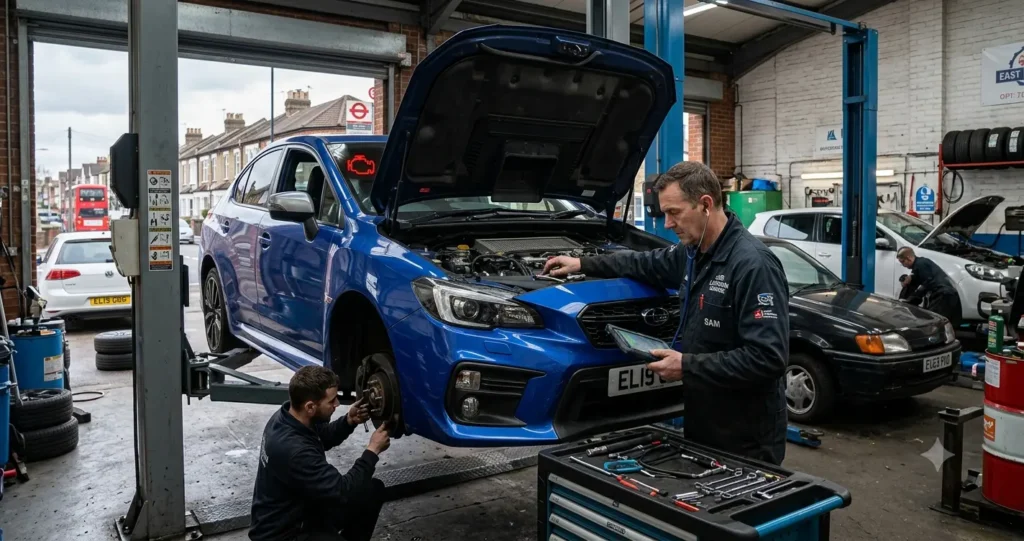
Most car problems don’t happen overnight. A strange noise you hear on Monday can turn into a breakdown by Friday if it’s ignored. The trouble is, modern cars are good at masking small issues — right up until the moment they can’t anymore. As a local East London garage, we see the same story every week: a driver waited “just a little longer” to get something checked, and a £60 fix became a £600 repair.
This guide walks through the ten warning signs that mean your car needs attention now, not next month. Whether you’re driving around Stratford, Leyton, East Ham, or anywhere else across East London, understanding these signals could save you money, time, and most importantly — keep you and other road users safe.
Why Ignoring Early Warning Signs Is a Costly Mistake
Every part in your vehicle is connected to another. A small vibration in the steering can be linked to worn suspension components, which in turn accelerates tyre wear, which then affects braking distance. Cars rarely fail because of one dramatic event; they fail because of a chain of small, ignored problems.
There are three reasons drivers put off getting these signs checked:
- They assume it will “sort itself out.” Mechanical problems don’t heal. A grinding noise doesn’t quietly disappear it gets worse.
- They’re worried about cost. Ironically, delaying a repair almost always increases the final bill because more parts become damaged.
- They don’t know what the sign actually means. Not every noise is serious, but without a diagnostic check, there’s no way to know for certain.
Our approach at our East London garage is simple: we inspect the issue, explain what we find in plain English, and give you clear repair advice before any work begins. No guesswork, no pressure — just an honest assessment so you can make the right decision for your vehicle.
1. Warning Lights on the Dashboard
Your dashboard is designed to talk to you. When the check engine light, battery light, oil pressure light, or ABS light comes on, your car’s onboard computer has detected something outside normal parameters.
A common misconception is that if the car “still drives fine,” the light can wait. In reality:
- A check engine light can indicate anything from a loose fuel cap to a failing catalytic converter or misfiring cylinder.
- An oil pressure warning should never be ignored driving with genuinely low oil pressure can destroy an engine within minutes.
- A battery or charging light usually means the alternator isn’t charging properly, and your car could stall without warning once the battery is drained.
If a light appears and stays on (rather than flashing briefly at startup), it’s worth booking a car diagnostics check as soon as possible. Diagnostic tools read the fault codes stored in your car’s computer, which narrows down the cause quickly rather than guessing.
2. Unusual Noises When Braking
Squealing, grinding, or a metallic scraping sound when you press the brake pedal is one of the clearest urgent signs a car will give you. Brake pads have wear indicators small metal tabs that create a high-pitched squeal once the pad material is running low. That’s your early warning.
If you hear grinding rather than squealing, it usually means the pad has worn through completely and metal is now contacting metal specifically the brake disc. At this stage, you’re not just looking at pad replacement; you may need discs replaced too, which is a bigger job and a bigger bill.
Braking is not an area to delay. If you notice:
- A longer stopping distance than usual
- The car pulling to one side when braking
- A soft or spongy brake pedal
- Any grinding or squealing noise
…book an inspection immediately. This is one of the few areas where “urgent” genuinely means today or tomorrow, not next month.
3. Strange Smells Inside or Outside the Car
Smell is an underrated diagnostic tool. Your nose often notices a problem before your ears or eyes do.
- A sweet, syrupy smell often points to a coolant leak, which can lead to overheating if not addressed.
- A burning rubber smell could mean a slipping drive belt or a hose rubbing against a hot engine part.
- A strong petrol smell may indicate a fuel leak — a genuinely urgent and potentially dangerous issue.
- A burning oil smell suggests oil is leaking onto a hot surface such as the exhaust manifold.
- A rotten egg smell is usually linked to the catalytic converter struggling to process exhaust gases properly.
Any persistent smell that wasn’t there before is worth a same-week garage visit at minimum. Fuel or burning smells should be treated as same-day, park-the-car-and-call-a-mechanic situations.
4. Vibrations Through the Steering Wheel or Seat
A car that vibrates noticeably at speed is telling you that something is out of balance, alignment, or condition. Common causes include:
- Unbalanced or unevenly worn tyres often felt through the steering wheel at motorway speeds.
- Warped brake discs usually felt as a pulsing sensation through the brake pedal when slowing down.
- Worn CV joints or driveshafts often accompanied by a clicking sound on tight turns.
- Engine mount wear felt as vibration through the whole cabin, particularly at idle.
Vibration issues rarely cause a sudden breakdown, but they accelerate wear on other components and affect your ability to control the car confidently, especially at speed or in wet weather.
5. Difficulty Starting the Engine
If your car is slow to start, needs several attempts, or makes a clicking sound instead of turning over, this is one of the most common reasons East London drivers contact a mobile mechanic or garage.
The usual suspects are:
- A weak or failing battery especially common after a cold snap, since low temperatures reduce battery efficiency.
- A failing alternator, which means the battery isn’t being recharged properly while you drive.
- A worn starter motor, which physically struggles to turn the engine over.
- Corroded battery terminals, which restrict the electrical connection even if the battery itself is healthy.
A simple battery condition check can usually identify the cause quickly. If you’re getting intermittent starting problems, don’t wait for the day it fails completely often at the worst possible moment, like early on a work morning.
6. Fluid Leaks Under the Car
Take a look at the ground where your car is parked. A few drops of water from the air conditioning system on a hot day is completely normal. Anything else deserves attention.
| Fluid Colour | Likely Source | Urgency |
|---|---|---|
| Amber/brown, oily | Engine oil | Book soon — check oil level immediately |
| Bright green, pink, or orange | Coolant | Urgent — risk of overheating |
| Dark red/brown, slippery | Transmission fluid | Book soon |
| Clear or light brown | Brake fluid | Urgent — affects braking performance |
| Clear, odourless (in warm weather) | AC condensation | Normal, no action needed |
If you’re ever unsure what a leak is, don’t just top up the fluid and hope for the best — a leak means fluid is escaping somewhere, and that somewhere needs to be found and fixed.
7. The Engine Overheats or the Temperature Gauge Rises
Modern engines run within a tight temperature range for good reason. If your temperature gauge creeps toward the red zone, or you see steam coming from under the bonnet, pull over safely as soon as you can and switch off the engine.
Continuing to drive an overheating car is one of the fastest ways to cause catastrophic (and expensive) engine damage, including a warped cylinder head or a blown head gasket. Common causes include:
- Low coolant level, often due to a leak
- A failing water pump
- A stuck thermostat
- A damaged radiator or blocked radiator fan
This is a genuine “stop the car” situation, not a “drive carefully to the garage” one.
8. The Air Conditioning Isn’t Working Properly
While not usually a safety-critical issue, a failing AC system is more than just a comfort problem. Weak airflow, warm air instead of cool, or unusual smells from the vents often point to:
- Low refrigerant due to a small leak
- A failing compressor
- A blocked cabin filter
- An electrical fault in the AC system
Left unaddressed, minor AC issues can develop into compressor failure, which is a considerably more expensive repair. If your AC performance has dropped compared to last summer, it’s worth booking a car AC repair check before the next heatwave, not during it when garages are busiest.
9. The Car Pulls to One Side or Feels Unstable
If your car drifts to the left or right when you’re not steering, or feels unstable over bumps, this points to one of a few issues:
- Uneven tyre pressure or wear
- Wheel alignment issues, often caused by hitting a pothole or kerb
- Worn suspension components such as bushes or shock absorbers
- Brake caliper issues causing uneven braking force
Beyond the annoyance, a pulling or unstable car handles unpredictably in an emergency stop or sudden manoeuvre which is exactly when you need your car to behave predictably.
10. Increased Fuel Consumption Without Explanation
If you’re filling up more often than usual and haven’t changed your driving habits, your car may be working harder than it should. Causes include:
- A dirty air filter restricting airflow to the engine
- Underinflated tyres increasing rolling resistance
- Oxygen sensor or fuel system issues
- A sticking brake caliper causing constant mild resistance
This one is easy to overlook because it develops gradually, but a proper diagnostic check can usually identify the root cause quickly, often as part of a routine service.
What to Do If You Notice Any of These Signs
If you’ve recognised one or more of these warning signs in your own car, here’s the sensible next step:
- Don’t panic, but don’t delay either. Most issues caught early are straightforward and affordable to fix.
- Note down exactly what you’re experiencing when the noise happens, what triggers the light, how long the smell has been there. This helps your mechanic diagnose faster.
- Book a diagnostic check or inspection. A proper visual and diagnostic inspection identifies the actual cause rather than guessing.
- Ask for clear repair advice before work begins. A trustworthy garage will explain the issue, the options, and the recommended repair, so you understand exactly what your car needs and why.
At our East London garage, this is exactly how we work. We inspect the vehicle, explain what we’ve found in plain language, and only proceed once you’re happy with the recommended repair. If your car can’t easily reach us, ask about our selected mobile mechanic support for checks, battery issues, and minor repairs across East London.
The Hidden Cost of “Just a Little Longer”
We understand why drivers put off a repair. Life is busy, money is tight, and a noise that doesn’t stop you from getting to work today doesn’t feel urgent. But there’s a pattern we see again and again at our East London garage, and it’s worth being honest about it.
A worn brake pad costs relatively little to replace. Left long enough, it wears through to bare metal and starts cutting into the brake disc turning a pad-only job into a pads-and-discs job, often two to three times the original cost. A small coolant leak is a simple hose or seal repair. Left unnoticed, it causes the engine to overheat, which can warp a cylinder head or blow a head gasket a repair that can run into four figures rather than a few hundred pounds.
This isn’t scaremongering; it’s simply how mechanical systems work. Small faults create extra load on neighbouring components, and that additional strain accelerates wear elsewhere. The financial argument for early diagnosis isn’t about being cautious for the sake of it — it’s usually the cheaper path in the long run, even before you factor in the inconvenience of an unexpected breakdown.
Driving Conditions in East London and Why They Matter
Where and how you drive changes which of these ten warning signs you’re more likely to encounter first. East London’s mix of dense urban traffic, frequent stop-start driving through areas like Stratford, Leyton, and East Ham, combined with the North Circular’s faster-moving sections, puts a particular kind of strain on a vehicle.
Stop-start traffic is hard on clutches, brakes, and cooling systems, since the engine spends more time idling and working at low speeds where cooling airflow is reduced. Frequent short trips — the school run, popping to the shops, a five-minute commute — mean the engine oil often doesn’t reach an optimal operating temperature for long enough to burn off moisture and contaminants, which can accelerate internal wear over time compared to longer, steadier journeys.
Pothole-heavy roads, common across many London boroughs, also take a toll on suspension components, tyres, and wheel alignment. If you’ve hit a pothole recently and have since noticed vibration, pulling to one side, or an unusual noise over bumps, that’s very likely connected, and it’s worth having your suspension and alignment checked specifically.
Common Mistakes Drivers Make When a Warning Sign Appears
Assuming a light will “reset itself
Some warning lights can briefly appear due to a loose connector or a temporary sensor glitch, but a light that stays on is telling you something real. Clearing it without understanding the cause just hides the problem rather than solving it.
Only addressing the symptom, not the cause
Topping up coolant without finding the leak, or ignoring a squeal until it becomes a grind, treats the visible symptom rather than the underlying fault and the underlying fault doesn’t go away on its own.
Waiting for a “convenient” time
We understand schedules are tight, but urgent signs like overheating, brake grinding, or a strong fuel smell genuinely can’t wait for a quiet weekend. These are the situations where prompt action protects both your wallet and your safety.
Not mentioning all the symptoms
When booking a repair, it helps enormously to mention everything you’ve noticed, even small details that seem unrelated. A noise that only happens when turning left, or a smell that only appears after motorway driving, can be exactly the clue a mechanic needs to diagnose the issue quickly.
Final Thoughts
Cars are full of early warning systems noises, smells, lights, and vibrations long before they actually break down. The drivers who avoid expensive repairs aren’t the ones with newer cars; they’re the ones who act on these signs early. If anything in this list sounds familiar, it’s worth getting it looked at properly rather than hoping it resolves itself.
If you’re in East London and noticing any of the signs above, book an inspection with our team. We’ll give you an honest, clear assessment and help you get back on the road with confidence.
Frequently Asked Questions
How do I know if a car noise is serious or normal?
As a general rule, any new noise that wasn’t there before is worth mentioning to a mechanic, even if it seems minor. Squealing, grinding, knocking, or clunking sounds are more likely to indicate a genuine issue than a soft hum or occasional rattle, but a diagnostic check is the only reliable way to be certain.
Is it safe to keep driving with the check engine light on?
It depends on whether the light is steady or flashing. A flashing check engine light usually signals a more serious fault, such as an engine misfire, and you should stop driving as soon as it’s safe to do so. A steady light means you should still get it checked soon, ideally within a few days, rather than continuing to drive on it for weeks.
How much does a car diagnostic check cost?
Diagnostic pricing varies depending on the vehicle and the complexity of the fault. Our diagnostic checks are designed to identify fault codes and vehicle issues before any repair work begins, so you know exactly what you’re paying for before committing to a repair.
Can I fix small issues myself before they become urgent?
Some basic checks, like topping up washer fluid or checking tyre pressure, are safe for most drivers to do themselves. However, anything involving brakes, fluid leaks, engine performance, or electrical systems should be inspected by a qualified mechanic, since incorrect DIY repairs can sometimes mask a bigger underlying problem.
Do you offer mobile mechanic support if my car won’t start?
Yes, we offer selected mobile mechanic support across East London depending on your location and the type of work required. This can be a practical option for starting issues, battery problems, and minor repairs when your vehicle can’t easily reach the garage.
How often should I get my car checked to avoid urgent repairs?
Regular servicing is the best way to catch small issues before they become urgent ones. Most vehicles benefit from a full service every 12 months or 10,000–12,000 miles, alongside a quick visual check whenever you notice something unusual.
What should I do if my car overheats while driving?
Pull over safely as soon as possible, switch off the engine, and do not open the bonnet immediately, as escaping steam can cause burns. Once the engine has cooled, check the coolant level if you’re comfortable doing so, and arrange for the vehicle to be inspected before driving it further.